Manufacturing
The timing of the event is not specified in the source input, but the latest quoted export spread in hot-rolled coil already serves as a practical trade signal for buyers, exporters and supply-chain intermediaries. As of June 8, 2026, China’s FOB offer level stands below comparable quotes from Japan, Turkey and India, and this matters not only as a price story but also as a market-execution signal affecting sourcing choices, order timing, delivery planning and document readiness in cross-border steel trade.
According to the provided information, as of June 8, 2026, China’s FOB export quotation for hot-rolled coil was $502 per ton. The same input shows comparable export quotations of $570 per ton for Japan, $645 per ton for Turkey and $538 per ton for India.
The source input also states that this pricing gap gives Chinese supply a visible cost advantage in the current export market. In addition, overseas demand is described as seeing a seasonal improvement, while geopolitical conflict has caused localized supply shortages.
Based on those conditions, Lange Steel Research Center expects China’s steel exports in June to post a slight year-on-year increase and a month-on-month stabilization and repair. The input further notes that this trend has direct reference value for overseas buyers assessing the cost competitiveness of Chinese suppliers, locking in short- to medium-term orders and optimizing import timing.
From an industry perspective, the most immediate impact falls on buyers that are actively comparing source options across exporting countries. A lower Chinese FOB quotation can influence supplier selection, negotiation pace and purchase timing, especially where buyers are managing short- to medium-term replenishment windows. What deserves closer attention is not only price, but whether quoted advantages can be converted into executable contracts supported by complete commercial and technical documentation.
Chinese exporters may face renewed inquiry activity if buyers interpret the current spread as an opportunity to reduce procurement costs. Analysis shows that the practical pressure point is likely to sit in contract execution rather than in quotation alone. Exporters need to pay attention to documentation consistency, specification confirmation, shipment coordination and any buyer-side compliance checks tied to cross-border procurement approval processes.
Intermediaries such as processors, distributors and logistics-linked service providers may also be affected if order flow stabilizes or improves. Observably, their exposure is tied to timing risk: when buyers accelerate imports because of a temporary price advantage, coordination around delivery sequence, product specifications, trade documents and after-sales traceability can become more important than the headline quote itself.
Analysis shows that a price advantage is most useful when it can move quickly through buyer review. Companies involved in export transactions should closely check whether quotation sheets, product specifications, inspection-related materials, quality records and shipping documents are aligned with customer requirements and tender language where applicable. The source input does not provide detailed execution rules, so this should be treated as a monitoring point rather than a confirmed change in enforcement.
Because the input links current pricing to short- and medium-term order decisions, exporters and service providers should pay attention to whether buyer demand shifts toward faster booking, smaller staged purchases or revised import timing. It is more appropriate to understand this as an execution signal in the market rather than proof of a lasting structural change.
For buyers, a lower FOB level may improve cost competitiveness, but procurement decisions still depend on delivery reliability and supplier qualification. Observably, firms should not rely on price comparison alone; they should also review whether suppliers can maintain specification consistency, delivery scheduling and post-shipment traceability if order volumes improve.
What deserves closer attention is whether customers, importers or downstream project buyers begin adjusting procurement language, bid evaluation logic or technical document requests in response to changing source-country economics. The provided information does not confirm such changes, but it does justify continued observation of how market participants translate price signals into procurement rules.
Analysis shows that this development is better read as a market-execution signal than as a confirmed policy shift with fully defined regulatory consequences. The core confirmed facts are the current quote spread, the noted seasonal improvement in overseas demand, localized shortages linked to geopolitical conflict, and the expectation of a slight year-on-year increase in June steel exports with month-on-month stabilization.
Observably, the rule-related relevance comes from how these market conditions can affect real trade behavior: supplier screening, import timing, bid comparison, document review and delivery planning. That means industry participants should continue watching whether buyers, intermediaries and exporters adjust their operating requirements in response to this pricing environment.
At this stage, the information is most appropriately understood as a practical indicator for trade and procurement decisions, rather than as evidence of a fully settled long-term shift. The current quote advantage of Chinese hot-rolled coil may support near-term export activity, but the real industry impact will depend on how buyers convert that advantage into orders, how suppliers execute delivery, and whether related procurement and compliance expectations become more explicit in subsequent market practice.
This article is generated from the user-provided news title, event timing and event summary. The specific official source link was not provided in the input, so further verification remains necessary. For this type of development, market participants usually continue to cross-check official notices, regulator or trade authority updates, customs and trade information, industry association releases, standard-setting documents and reporting from authoritative media. What still needs observation includes any later clarification in market language, compliance expectations, tender document changes, buyer feedback and actual execution by companies in the supply chain.
Between 2026-06-01 and 2026-06-10, a phased set of trade actions in Japan, Korea and Türkiye reshaped the near-term export environment for cold-rolled steel products. The reported changes cover an anti-dumping case launch, a temporary anti-dumping duty, and high final duties across multiple cold-series categories, drawing attention from exporters, overseas buyers, processors and compliance teams because galvanized steel and color-coated products are among the product lines most directly exposed to changes in supplier qualification, trade compliance and procurement planning.
According to the provided event summary, Japan started an anti-dumping investigation into cold-rolled coils in early June 2026. Korea formally imposed temporary anti-dumping duties on galvanized and cold-rolled steel. Türkiye issued high final duties covering cold-rolled, galvanized and color-coated products. The measures were introduced in phases between 2026-06-01 and 2026-06-10 and together formed an uncommon sequence of trade barriers across three core consumption markets.
The same summary states that these measures directly squeeze the export share of lower-end Chinese cold-series steel products. It also identifies galvanized steel and color-coated sheet products, including Galvanized Steel and Sheet packaging, as key exposed categories, while indicating that overseas customers are being pushed to reassess supplier qualifications, certification compliance and alternative sourcing arrangements.
From an industry perspective, exporters are not only dealing with tariff pressure but also with a stricter transaction environment. Where duties or investigations are involved, the practical impact often reaches quotation validity, contract review, shipment scheduling and customer acceptance of product scope. What deserves closer attention is whether product classification, supporting documents and customer-facing compliance files remain aligned with the new trade conditions in each destination market.
For procurement teams and import-side buyers, the immediate issue is not limited to landed cost. Analysis shows that buyers may need to review whether existing suppliers still meet internal sourcing rules once trade barriers affect core cold-series categories. This can shift attention to qualification records, certification status, traceability materials, technical documents and substitution feasibility, especially where galvanized steel and color-coated products are central to ongoing purchasing plans.
For downstream processors, distributors and channel operators, the impact may appear in order allocation, product mix decisions and delivery coordination. Observably, when multiple markets tighten access at the same time, the burden can move to specification matching, stock planning and customer communication around acceptable alternatives. The relevant focus is whether procurement documents, inspection records and product descriptions remain consistent with revised trade and compliance expectations.
Certification-related service providers, inspection bodies and internal compliance teams may see a more active role in transaction support. This is because overseas customers reassessing supplier qualifications are likely to place more weight on document completeness, technical consistency and the usability of compliance evidence during procurement review and shipment approval, even where the input does not provide detailed enforcement procedures.
Analysis shows that companies active in galvanized steel, color-coated products and Sheet packaging should review how their current product descriptions, technical files, qualification materials and trade documents are presented to customers in the affected markets. This is not yet a statement of uniform execution outcomes, but a practical review point given the reported tightening in trade treatment.
What deserves closer attention is the exact wording and follow-on implementation signals attached to the reported measures in each market. Because the provided input does not include detailed procedural language, companies should avoid assuming that one market's treatment automatically mirrors another's. Continued monitoring of official expressions, trade administration notices and procurement-side interpretation remains important.
For exporters, buyers and supply-chain service teams, delivery commitments may need closer review where affected categories are involved. Observably, if customers are reassessing alternative sourcing or supplier eligibility, then lead times, confirmation cycles and order execution may become less predictable. The more practical response at this stage is to strengthen communication around shipment readiness, documentation status and replacement supply planning rather than assume immediate market normalization.
Analysis shows that supplier qualification may become a more visible commercial issue alongside pricing. Companies should therefore pay attention to whether certification files, quality records, testing documents and traceability materials are ready for customer review, especially where the affected products are already important export lines. This should be understood as a preparedness issue, not as proof of a single mandatory new standard in the input.
Observably, this development is more than a routine tariff update because the measures arrive across three major markets within a short time window and target overlapping cold-series steel categories. At the same time, it is more appropriate to understand this as a combined execution signal and market-access warning rather than a fully settled end-state for all trade flows. The reason is that the input confirms the rule changes and their immediate pressure on Chinese low-end cold-series exports, but does not provide the full downstream detail of enforcement practice, customer behavior or replacement sourcing outcomes.
From an industry perspective, the most useful reading is that compliance positioning, procurement review and supplier screening are moving closer to the center of trade execution for galvanized and color-coated products. Continued attention should therefore focus on how market participants translate these measures into document requirements, qualification checks and purchasing decisions.
The reported actions in Japan, Korea and Türkiye indicate that cold-series steel trade conditions changed materially during 2026-06-01 to 2026-06-10, with direct relevance for Chinese exports of galvanized steel and color-coated products. The immediate significance lies less in broad market conclusions and more in the need for exporters, buyers and service providers to recheck supplier eligibility, compliance materials and delivery assumptions in affected business lines.
At this point, it is more appropriate to understand the event as a concrete tightening in trade treatment combined with a continuing need to observe execution details. A cautious and neutral reading is that the rule change has already become relevant for transactions, while the full market response, procurement adjustment and compliance interpretation still require follow-up observation.
This article is generated from the user-provided news title, event timing and event summary. For developments of this type, commonly relevant source categories may include official notices, releases from trade or customs authorities, information from regulatory bodies, industry association communications, standard-setting documents and reporting by authoritative media. Specific official source links were not provided in the input, so they still need to be verified on an ongoing basis.
Further observation is still needed on detailed implementation language, certification and compliance interpretation, changes in tender or procurement documents, market feedback, and how companies actually adjust sourcing and delivery arrangements after the phased measures take effect.
On June 14, 2026, a new agreement between the United States and Iran reopened the Strait of Hormuz to free navigation and ended the U.S. naval blockade of Iranian ports, bringing a practical reset to steel shipping between China and the Middle East. For steel exporters, importers, distributors, and supply chain service providers, the development matters because it directly affects port access, freight costs, and the pace at which delayed orders may move again across one of the most important trade corridors for China’s Middle East steel business.
The confirmed facts are limited but commercially significant. From June 14, 2026, the Strait of Hormuz resumed free passage following a U.S.-Iran agreement, and the U.S. Navy lifted its blockade of Iranian ports. Core Gulf ports that had previously faced disruption, including Jebel Ali and Dammam, are set to reopen for steel imports and exports. Based on the information provided, shipping costs for China’s steel exports to the Middle East may fall by 30% to 50%, while the delivery of backlogged orders is expected to speed up. In 2025, the Middle East accounted for 14% of China’s total steel exports, and Saudi Arabia and the UAE together took in more than 11 million tonnes. The reopening is described as directly supportive for hot-rolled coil, coated steel products, and seamless pipe.
For direct trading companies, the clearest effect is on logistics execution rather than on demand itself. Analysis shows that lower shipping costs and the reopening of key Gulf ports could improve the economics of export shipments and help release orders that were delayed when the route was constrained. What deserves closer attention is whether freight savings translate quickly into new bookings and smoother vessel scheduling.
For mills and downstream manufacturers supplying hot-rolled coil, coated products, and seamless pipe, the reopening mainly affects production planning and shipment rhythm. If delayed cargo starts moving faster, producers may need to coordinate output, documentation, and loading schedules more tightly with trading partners. The practical issue is less about headline policy and more about whether delivery timing normalizes across existing contracts.
For channel distributors and buyers in Saudi Arabia and the UAE, the event matters because these two markets accounted for more than 11 million tonnes of China’s steel exports in 2025. From an industry perspective, restored access through major Gulf ports could improve replenishment timing and reduce uncertainty around inbound cargo. The near-term focus is likely to be on shipment visibility, arrival sequencing, and the handling of previously delayed material.
For freight forwarders, shipping agents, and related service providers, the reopening creates an immediate need to reassess routing, port handling, and backlog management. Observably, the key business impact lies in reactivating normal trade lanes and aligning vessel, port, and customs-related workflows with the new situation. Service providers will need to watch how quickly restored passage translates into stable execution on the ground.
The reopening is an important signal, but companies still need to verify how quickly normal operations return in practice at affected ports and along the shipping chain. For commercial teams, the core task is to distinguish an announced reopening from confirmed loading, transit, and discharge conditions.
Given the direct relevance to hot-rolled coil, coated steel products, and seamless pipe, firms with exposure to these categories should review shipment queues and customer commitments first. Saudi Arabia and the UAE also deserve priority attention because of their scale within China’s Middle East steel exports.
Where orders were delayed, exporters and service teams should focus on delivery schedules, shipping documents, and updated customer communication. Analysis shows that operational frictions often appear during the transition from disruption to recovery, especially when backlog shipments need to be resequenced.
The information provided indicates that shipping costs may decline by 30% to 50%, but companies should monitor whether that relief is sustained across actual bookings. What deserves closer attention is not only the initial drop in logistics costs, but also whether the lower-cost environment remains stable enough to support pricing and margin decisions.
From an industry perspective, this development is best understood as a strong operational signal for the resumption of steel trade flows between China and the Middle East. It points to improved logistics access, lower transport pressure, and faster movement of delayed orders. At the same time, it is more appropriate to understand this as a change in shipping conditions rather than as proof of a broader market shift. The industry still needs to observe how consistently port reopening, freight reductions, and backlog clearance are implemented in real transactions.
The immediate significance of the reopening lies in restored access to a major export corridor that matters materially to China’s steel trade with the Middle East. For now, a neutral reading is the most appropriate one: the event improves the operating environment for exporters, buyers, and logistics providers, especially in key Gulf markets and in major export product categories, but its full commercial effect still depends on execution. Current evidence supports viewing it as a meaningful near-term logistics recovery signal that warrants continued monitoring.
This article is based on the user-provided news title, event date, and event summary. The specific official source link was not provided in the input, so the details still require continued verification against source materials typically relevant to this type of development, such as official announcements, company disclosures, industry association updates, authoritative media reporting, and related trade or port information. Areas that warrant further observation include the practical reopening status of relevant ports, the actual pace of backlog clearance, and whether reported freight-cost relief is sustained in ongoing steel shipments.
On June 17, 2026, a joint initiative from China’s steel circulation sector signaled a clearer industry stance against below-cost dumping, malicious order grabbing, and disorderly steel export competition. For exporters, overseas importers, distributors, and channel partners, the development matters less as a routine statement and more as a compliance and procurement signal tied to pricing discipline, trade risk, and the handling of export orders that could affect delivery decisions and cross-border business relationships.
According to the information provided, on June 17, 2026, the circulation branch of the China Iron and Steel Association, together with more than 40 provincial and municipal steel trade associations, issued an anti-involution action initiative for the steel circulation industry. The initiative explicitly opposes below-cost dumping and malicious order grabbing, and it also stresses the need to regulate steel export order. The stated purpose includes avoiding blind competition for overseas orders that could trigger trade friction. The summary further indicates that the initiative is aimed at current behavior by some exporters that use low-price bidding and disrupt international market order, and that it carries compliance warning value and procurement reference value for overseas importers, distributors, and channel partners.
From an industry perspective, exporters are the most directly affected group because the initiative speaks to how orders are won, how prices are set, and how overseas business is pursued. Analysis shows that these companies should pay closer attention to internal pricing discipline, bid review procedures, contract consistency, and document retention around quotations and order acceptance. The practical issue is not a newly published regulation in the legal sense, but a stronger industry signal that aggressive underpricing and disruptive bidding behavior are drawing organized attention.
For importers, distributors, and channel partners, the initiative serves as a warning that unusually low offers may carry more than commercial upside. Observably, buyers may need to look more carefully at supplier credibility, quotation logic, delivery commitments, and the supporting trade documents tied to an order. In procurement practice, this can affect supplier screening, bid comparison, contract review, and later-stage quality and after-sales traceability if a low-price transaction creates performance or dispute risk.
Channel traders and supply chain service providers may also feel the impact because they often sit between pricing decisions and final delivery. Analysis shows that order allocation, handover records, shipment coordination, and claims handling may all become more sensitive if market participants start treating abnormal low-price competition as a compliance warning sign. What deserves closer attention is whether customers begin asking for clearer commercial documentation and more consistent delivery commitments before confirming business.
Analysis shows that companies involved in export business should examine whether quotation approvals, discount authority, and bid submission processes are sufficiently controlled. The immediate concern is not only commercial margin, but whether pricing behavior could later be viewed as disorderly competition in a way that increases trade friction or undermines counterpart confidence.
For buyers and channel partners, it is advisable to pay closer attention to supplier qualifications, contract terms, order documentation, and delivery capability when evaluating unusually competitive offers. Where supporting technical documents, test records, or transaction files are part of the deal process, keeping those materials complete may help reduce later disputes over quality, execution, or responsibility.
The provided information does not include detailed enforcement arrangements, so it would be premature to describe the initiative as a completed compliance regime. It is more appropriate to understand this as a meaningful execution signal from industry organizations. Companies should therefore monitor whether subsequent official wording, tender documents, transaction requirements, or association guidance begin to reflect stricter expectations around export order conduct.
Because the initiative explicitly links disorderly overseas order competition with potential trade friction, export-related businesses should consider that pricing decisions can affect more than order intake. Analysis shows that contract execution, delivery scheduling, channel stability, and after-sales handling may all become more exposed if transactions are built on abnormal price competition rather than sustainable commercial terms.
Observably, this development is best read as an organized industry warning rather than as a fully detailed new regulatory framework. Its significance lies in the fact that trade associations are jointly identifying below-cost dumping, malicious order grabbing, and disorderly export competition as conduct requiring correction. From an industry perspective, that does not by itself define final enforcement standards, but it does raise the practical importance of compliance review, procurement caution, and closer attention to how export business is pursued and documented.
The core meaning of this event is that parts of China’s steel circulation sector are publicly signaling stronger discipline around export pricing and order competition. For market participants, the reasonable takeaway is not to assume an immediate uniform outcome, but to recognize a clearer expectation that overseas steel business should avoid disruptive low-price practices that could damage market order or trigger trade friction. At the current stage, it is more appropriate to understand the initiative as a concrete execution signal that merits continued observation rather than as a closed and fully settled rule change.
This article is generated based on the user-provided news title, event date, and event summary. For developments of this type, relevant source categories typically include official notices, regulator releases, customs or trade authority information, industry association communications, standard-setting documents, and reporting by authoritative media. A specific official source link was not provided in the input, so further verification remains necessary. What still deserves follow-up attention includes any later implementation detail, compliance interpretation, tender document changes, market feedback, and how enterprises actually adjust export, procurement, and channel practices in response.
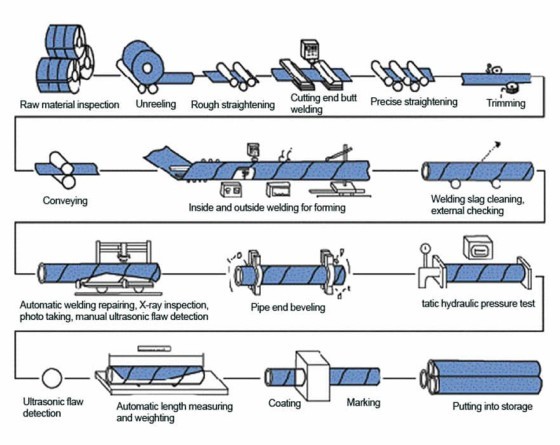
1.Uncoiling and Straightening: We need to have our carefully-selected steel plates of top quality straightened using the straightening machine to make them flat and straight, which lays a solid foundation for subsequent forming and welding.
2.Forming: Under the action of the forming machine, the steel plates pass through multiple passes of forming rollers and are gradually curled into a tube shape. During the molding process, it is crucial to control the spacing and speed of the rollers to ensure the accuracy of the tube diameter and wall thickness.
3.Internal and External Welding: We use advanced submerged arc welding machines and double-sided welding machines to achieve welding on both inner and outer sides. During the welding process, welding equipment and automatic tracking systems ensure the quality of welds.
4.Pipe Cutting: After welding is completed, we accurately cut the pipes using plasma technology according to the specified size.
5.Inspection: Advanced technical means such as ultrasonic flaw detector and X-ray inspection equipment are used to comprehensively inspect the weld to ensure its quality. In case of any defect, we need to carry out timely repair and welding until each welded pipe meets the standard.
6.Pipe End Processing: The spiral welded pipe is cleaned by a cleaning machine to remove oil stains and impurities on the surface. An Anti-corrosion treatment needs to be carried out through spraying equipment to provide long-term and effective protection for welded pipes. After this series of treatments, a high-quality spiral welded pipe is finally born.
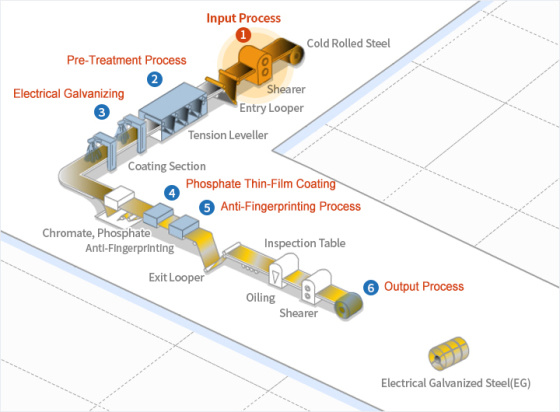
1. lnput Process: Equipment at the entry point of the electrogalvanizing line consists of a pay-off reel, a shearing M/C, a welding M/C, a looper and a tension leveler. The pay-off reel transports stacked or cold rolled steel materials to the shearing machine which cuts and connects them in preparation for welding. Then comes the welding.
2. Pre-Treatment Process: An electrolytic cleaning line consists of an electrolysis tank, an acid bath and a rinse tank to remove contaminants and oxide films from the surface of the steel before electroplating.
3. Electrical Galvanizing: The CAROSEL method, among other electric galvanizing, involves the plating of one side at a time by means of a conductor roll. This process produces two-sided, single-sided, differential-sided plated sheets. There is also the horizontal type where two sides of a sheet are plated at the same time to produce a two-sided plated sheet.
4. Phosphate Thin-Film Coating: A phosphate thin-film is applied to the surface of the zinc layer through chemical or electrochemical reactions. The film is intended to provide temporary anti-corrosion protection and to generate a secure painting substrate.
5. Anti-Fingerprinting Process: An organic, inorganic or organic-inorganic hybrid film is applied to the surface of sheet steel in order to supplement its corrosion resistance and to enhance desirable properties such as resistance to fingerprint marks and workability.
6. Output Process: The exit point of the line includes an output looper, tension reel, and an automatic packaging line to protect the products after coil winding.
Leave A Message
If you are interested in our products and want to know more details, please leave a message here, we will reply you as soon as we can.